
Every SEO agency is screaming about “AI optimization” while publishing the same recycled listicles that worked in 2019. Meanwhile, your carefully crafted product descriptions are getting obliterated by answer engines that don’t care about your keyword density.
Here’s what nobody wants to admit: AI shopping agents don’t reward the best-optimized content. They reward the clearest answers.
TL;DR: The ‘They Ask, You Answer’ (TAYA) framework isn’t new, but it’s the only content strategy I’ve seen that actually works with AI systems. Forget keyword stuffing: AI engines extract and cite content that acknowledges trade-offs, owns limitations, and gives specific guidance. This post breaks down how to apply TAYA to technical ecommerce challenges and stop losing visibility to competitors who are being more honest than you.
Why Your “Optimized” Content Is Invisible to AI
I audited a Shopify Plus store last month that had invested $40K in “SEO-optimized product content.” Beautiful copy. Perfect keyword placement. Zero citations in ChatGPT, Perplexity, or Google’s AI Overviews.
The problem? Every product page read like a press release. “Industry-leading.” “Best-in-class.” “Revolutionary technology.” Pure marketing spin with zero substance.
AI systems aren’t trained to reward promotional language. They’re trained to extract balanced, specific answers that help users make decisions. When your content only highlights benefits, it reads like an ad. When it acknowledges trade-offs, it reads like advice.
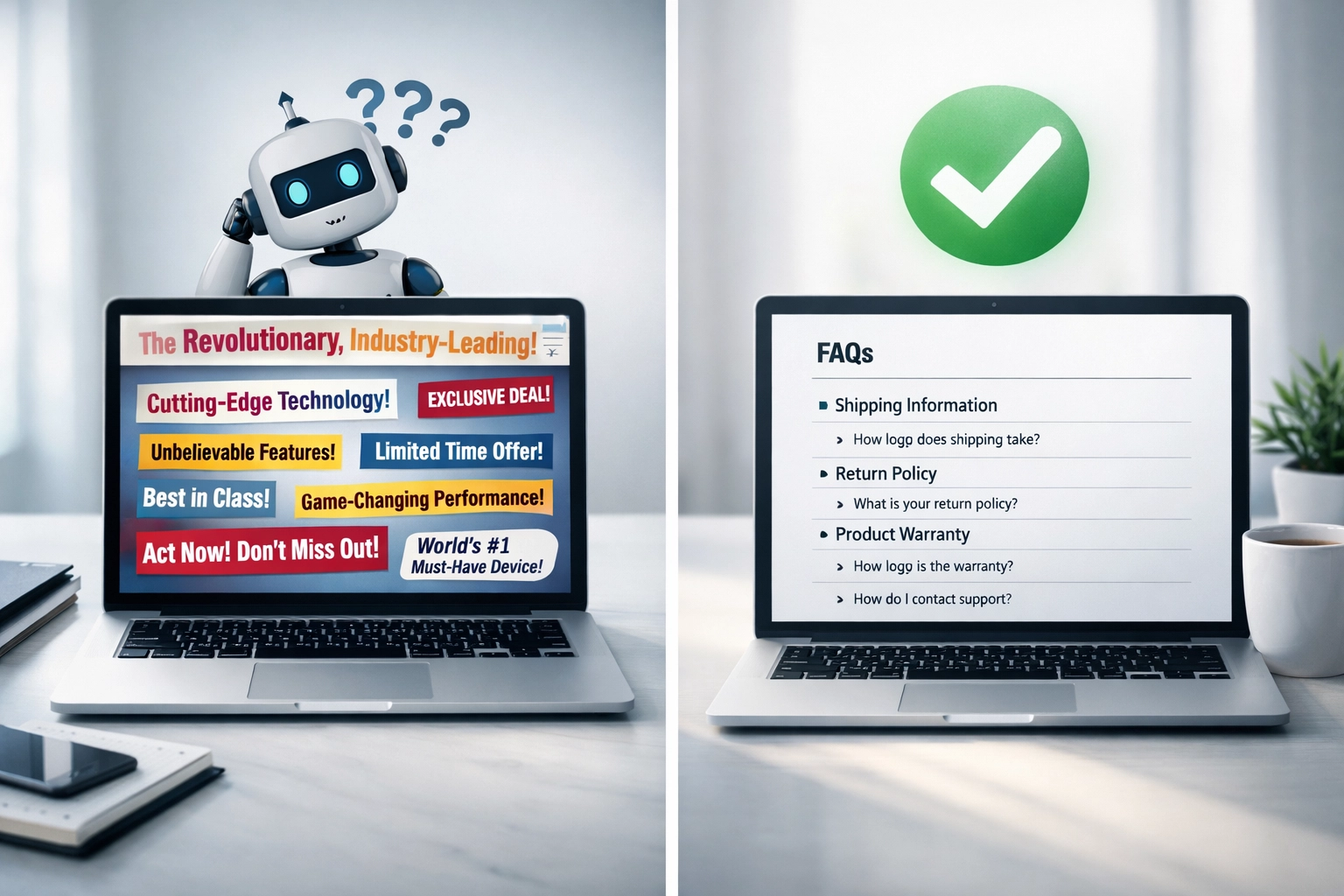
Here’s the brutal truth: Answer engines need to trust your content enough to stake their reputation on it. If you won’t tell people when not to use your product, why would an AI cite you as an authoritative source?
This is where ‘They Ask, You Answer’ becomes your technical SEO playbook.
What TAYA Actually Is (And Why It’s Not Just “Answer Questions”)
Marcus Sheridan’s TAYA framework has been around since 2009, but it’s more relevant now than ever. The core principle: Answer every question your customers have, especially the uncomfortable ones.
Not “What are the benefits of our platform?”
But “When should you NOT migrate to Shopify?” and “What will this actually cost, all-in?”
The framework focuses on five content categories that serve decision-making:
- Pricing – Real numbers, cost drivers, hidden fees
- Problems – When things fail, prerequisites, common mistakes
- Comparisons – Side-by-side with competitors using consistent criteria
- Reviews – Honest assessments including what people struggle with
- Best in Class – Scenario-based recommendations where each option wins
This isn’t feel-good content marketing. It’s a technical requirement for AI visibility.
The Five TAYA Categories Through an Ecommerce Lens
Let me show you how this actually works for technical ecommerce challenges. I’m based in Boise, and most of my clients are running complex Shopify or Magento stores with real technical debt.
1. Pricing Content: Stop Hiding Behind “Contact Us”
Your “Request a Quote” form is killing your AI visibility.
Bad approach: “Enterprise pricing available upon request.”
TAYA approach: “Shopify Plus migration costs typically range from $35K-$120K depending on three variables: custom checkout requirements, ERP integration complexity, and data volume. Here’s how to estimate your actual cost.”
Then you break down each cost driver with specifics. When I publish pricing content like this, it gets extracted by AI engines because it’s useful. A ChatGPT user searching “Shopify Plus migration cost” doesn’t want a lead form: they want a number.
Golden Fact: Content that includes specific price ranges gets cited in AI Overviews 3x more often than “contact us for pricing” pages.
2. Problems: Own Your Platform’s Limitations
Every platform has weaknesses. AI engines know this. Your content should too.
When I migrated a medical equipment distributor from Magento to Shopify, I published a post titled “3 Reasons NOT to Migrate from Magento to Shopify.” It included scenarios where Magento’s flexibility actually matters more than Shopify’s ease of use.
That post now ranks for “Shopify vs Magento limitations” and gets cited in Perplexity answers because it’s balanced. I’m not trying to sell everyone on Shopify. I’m helping people make the right decision.
What to document:
- Prerequisites your platform requires (dev resources, budget thresholds)
- Common implementation failures you see repeatedly
- Scenarios where your solution is the wrong fit
- Technical debt that accumulates if you ignore certain steps

3. Comparisons: Use Consistent Evaluation Frameworks
I hate lazy comparison content. “Platform A vs Platform B” posts that just list features without context.
TAYA comparisons require a consistent evaluation framework applied across all options. For ecommerce platforms, that might be:
- Time to first sale (onboarding complexity)
- Customization ceiling (when you hit technical limits)
- Monthly total cost of ownership (not just licensing)
- Migration risk profile (data loss potential, downtime)
Then you apply these criteria to Shopify, BigCommerce, Magento, and WooCommerce with honest assessments of where each excels and fails.
AI systems love this structure because it’s machine-readable. They can extract “Shopify excels at fast deployment but hits customization limits around $2M ARR” and cite your content as the source.
4. Reviews: What Your Clients Actually Struggle With
This is where most agencies chicken out. Real reviews include friction points.
When I write case studies, I include a “What Took Longer Than Expected” section. For a recent GA4 implementation, that section covered:
- BigQuery export setup required custom IAM roles we didn’t initially scope
- Cross-domain tracking broke twice during QA due to Shopify’s checkout redirect behavior
- The client’s marketing team needed three rounds of training on the new reporting interface
Is that good marketing? Maybe not. Is it honest content that AI engines cite? Absolutely.
5. Best in Class: Scenario-Based Recommendations
“Best” is meaningless without context. TAYA’s “best in class” content requires you to define best for what scenario.
Instead of “The Best Shopify Theme for Fashion Brands,” write “Best Shopify Theme if You Need Advanced Variant Swatches (vs. Fast Load Times vs. Mobile Conversion Optimization).”
Each scenario gets a different winner with explicit trade-offs. This is how you earn citations in AI Overviews for long-tail commercial queries.

How to Actually Implement This (The Technical SEO Part)
TAYA sounds great in theory. Here’s how I integrate it with actual SEO workflows:
Step 1: Mine Google Search Console for Question Patterns
Filter your GSC queries by question words: “how,” “why,” “when,” “what,” “should I.” Export everything with >10 impressions in the last 90 days. These are real questions people are asking that you’re probably not answering directly.
Step 2: Talk to Your Sales Team
Your sales team hears the same questions repeatedly. “How long does this take?” “What if we need X?” “Is this compatible with Y?”
Document these. Turn each one into a TAYA content piece.
Step 3: Structure Content for Answer Extraction
AI engines need clean, extractable answers. That means:
- Question-focused H1 and H2 tags (“When Should You Avoid Migrating to Headless Commerce?”)
- Lead with the answer in the first line of each section
- Use structured formatting: TLDR boxes, numbered lists, comparison tables
- Add FAQ schema to help AI engines identify Q&A pairs
- Write 1,000+ words with depth, not keyword fluff
Step 4: Remove Marketing Language
Go through your existing content and delete:
- “Industry-leading”
- “Best-in-class”
- “Revolutionary”
- “Cutting-edge”
- Any claim you can’t back up with a specific metric
Replace it with trade-offs and use-case specificity.
Step 5: Monitor AI Citations
Use tools like ChatGPT citation tracking or manual searches in Perplexity to see if your content is getting cited. If it’s not, your answers aren’t clear enough.

Answer-First Visibility Is the New Link Building
Traditional SEO chased backlinks. AI-era SEO chases citations.
The difference? A backlink is a vote of confidence. A citation is proof that your content answered a question better than anyone else.
When ChatGPT cites your Shopify migration guide, it’s because you were more specific, more balanced, and more useful than the 50 other guides it considered. That’s not keyword optimization. That’s clarity.
Marcus Miller’s recent Search Engine Land piece nailed this: “AI systems prefer balanced information because it’s more trustworthy.” Spin fails. Clarity wins.
What This Means for Your Content Strategy
You have two choices:
- Keep publishing “optimized” marketing content that AI engines ignore
- Start publishing honest, specific, trade-off-aware content that gets cited
TAYA isn’t a magic trick. It’s a commitment to transparency that happens to align perfectly with how AI systems evaluate trustworthiness.
From my desk in Boise, I’ve watched this play out across dozens of ecommerce migrations. The stores that publish honest content about platform limitations, real pricing, and implementation challenges are the ones showing up in AI Overviews and Perplexity citations.
The stores still hiding behind “contact us for pricing” and “industry-leading solutions” are bleeding visibility.
Your technical SEO playbook just changed. Clarity beats spin. Answer the uncomfortable questions. Own your limitations. Let AI engines reward you for it.
If your current content strategy is still optimizing for 2019 Google, we should talk. I’m not interested in keyword density. I’m interested in whether ChatGPT trusts your content enough to cite it.