
I see it every week. A Marketing Director books a call with me and immediately asks for an aggressive backlink campaign. They have the budget, they have the ambition, and they are desperate to see the needle move on their E-commerce Growth.
But when I open up their site architecture or run a preliminary crawl, I don’t see a platform ready for growth. I see a leaky bucket.
Asking for high-level PR and link acquisition before you have solidified your technical infrastructure is like trying to put a roof on a house that has no walls. You aren’t building an asset; you are just decorating a disaster.
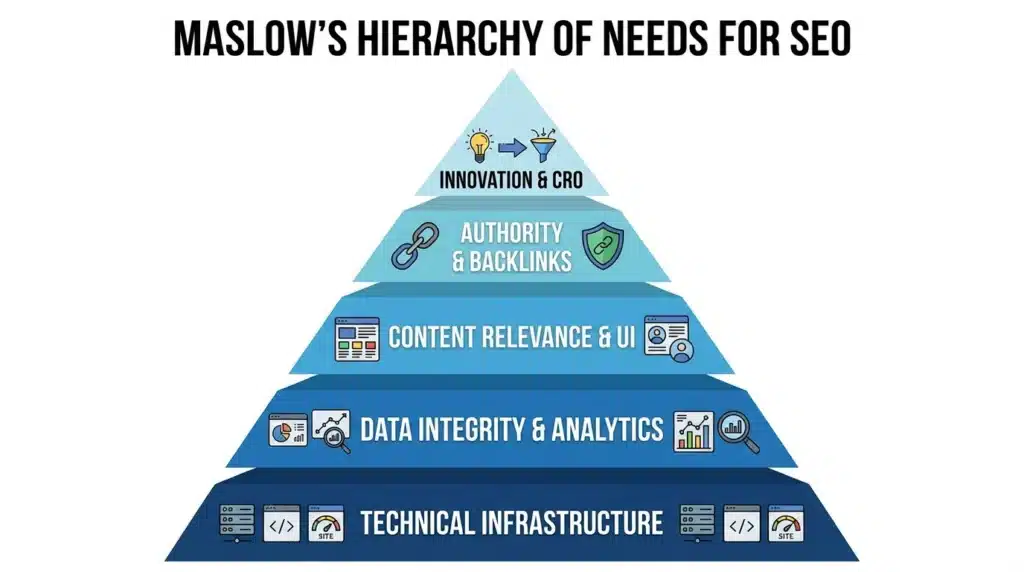
This is where Maslow’s Hierarchy of Needs comes in. Just as humans cannot focus on self-actualization if they are starving, a website cannot rank for competitive keywords if it cannot be crawled efficiently.
I am Sean Edgington, a Senior Digital Strategist based in Boise, Idaho. I work with clients globally to stop the bleeding and build systems that actually generate revenue. Here is how I apply Maslow’s framework to forensic SEO.
The Stakes: Revenue vs. Vanity Metrics
Why does this hierarchy matter? Because ignoring it destroys ROI.
I have audited massive Magento builds where the client was obsessing over blog content strategy while their faceted navigation was generating millions of low-quality, indexable URLs. They were burning their crawl budget and diluting their authority.
If you skip the foundational stages of this hierarchy, you might see a temporary spike in traffic from a paid campaign or a lucky viral post. But it won’t stick. Revenue requires stability. If your Data Integrity is compromised or your server response times are sluggish, you are essentially paying to send traffic to a site that is designed to lose money.
Level 1: Physiological Needs (Technical Infrastructure)
At the base of the pyramid is survival. In the human world, this is food and water. In the Digital Strategy world, this is Technical SEO.
If Google cannot find your pages, nothing else matters. Before I ever look at a keyword list, I look at the plumbing.
- Crawlability & Indexing: I use Screaming Frog to simulate exactly how a search engine bot experiences your site. I am looking for crawl loops, 404 errors, and orphan pages.
- Server Performance: Is your TTFB (Time to First Byte) under 200ms? If not, you are frustrating bots and humans alike.
- Architecture: Is your site structure logical? Does it follow a flat hierarchy where products are no more than three clicks from the homepage?
If I find critical render-blocking JavaScript or a robots.txt file that is inadvertently blocking key resources, we stop everything. We fix the foundation. There is no point in optimizing a page that Google can’t read.
Level 2: Safety Needs (Data Integrity & Analytics)
Once the site is alive and accessible, we need to ensure it is safe. In my view, “safety” in SEO isn’t just about HTTPS (though that is mandatory); it is about the safety and accuracy of your data.
You cannot make high-level decisions based on corrupted data.
- GA4 Configuration: Most out-of-the-box GA4 setups are garbage. I ensure that events are firing correctly and that cross-domain tracking is actually working.
- Google Tag Manager (GTM): I audit GTM containers to remove legacy tags that are slowing down the site and ensuring triggers are firing on the correct interaction.
- Schema Markup: This is how we speak Google’s language. I implement structured data (JSON-LD) to explicitly tell search engines what a page is about such as whether it is a Product, an Article, or a Local Business.
Without this layer, you are flying blind. You might think your SEO is failing when, in reality, your attribution modeling is just broken.
Level 3: Belonging (Content Relevance & UI)
Now that the site works and we can measure it, we look at “Belonging.” Does the content on the page actually match the user’s intent?
This is where traditional “on-page SEO” lives. But I don’t just mean stuffing keywords into H1 tags.
- Semantic Relevance: I analyze the top 10 results for your target keywords to understand the semantic entities Google expects to see.
- User Experience (UX): SEO and UX are the same thing today. If a user lands on a product page and shifts around due to Cumulative Layout Shift (CLS), they bounce. Google sees that bounce and devalues the page.
- Internal Linking: I use internal links to create “clusters” of content. This signals to Google which pages are the most important and passes authority from your high-traffic blog posts to your high-conversion product pages.
Level 4: Esteem (Authority & Backlinks)
This is the “Ego” layer. This is where most agencies want to start because it sounds sexy. “We will get you on Forbes!”
But remember, we only look at this once levels 1 through 3 are airtight.
- E-E-A-T: Experience, Expertise, Authoritativeness, and Trustworthiness. I audit your author bios, your “About Us” page, and your citation consistency.
- Link Acquisition: I focus on quality over quantity. One link from a niche-relevant, high-traffic domain is worth a thousand directory submissions. I look for digital PR opportunities where your brand can provide unique data or expert commentary.
Level 5: Self-Actualization (Innovation & CRO)
At the top of the pyramid is Self-Actualization. This is where you stop following competitors and start setting the pace.
- A/B Testing: We use the solid data from Level 2 to run experiments. Does changing the H2 on the landing page improve dwell time?
- Advanced Features: This includes implementing things like programmatic SEO or advanced product filtering that creates new, indexable entry points for long-tail queries.

The “Digital Architect” Approach
The reason so many SEO campaigns fail is that they rely on a checklist of “best practices” without understanding the specific context of the business.
I view myself as a Digital Architect. I don’t just patch holes; I look at the structural integrity of the entire digital asset.
“Best practices” say you should have a blog. But if you are a B2B industrial manufacturer, a generic blog might be a waste of resources. You might need a robust technical library or a CAD drawing repository instead.
My philosophy is simple: Data dictates direction.
I don’t guess what your users want. I look at the search query reports, the heatmaps, and the conversion paths. I act as a forensic auditor to strip away the assumptions and look at the raw reality of how your site performs.
I believe in transparency. If your site needs a complete migration before we can do SEO, I will tell you. If your product descriptions are thin and unhelpful, I will tell you. I am not here to make you feel good; I am here to make you profitable.
Conclusion
If you are trying to reach the top of the pyramid of Self-Actualization and market dominance without fixing the Physiological needs of your website, you are wasting your time.
You need a strategy that respects the hierarchy. You need to secure your technical foundation, verify your data, and build content that serves a purpose before you worry about vanity metrics.
I am based in Boise, but I help businesses around the world fix these exact problems.
If you are ready to move past the fluff and get a forensic audit of your digital presence, let’s talk.
Would you like me to perform a preliminary “Level 1” technical scan of your website to see if your foundation is secure?