

You’ve probably spent months optimizing your Shopify or Magento store for Google. Product pages, meta descriptions, structured data, canonical tags: the whole technical SEO playbook.
But here’s the uncomfortable truth: Your site could be ranking on page one and still be completely invisible to AI.
TL;DR: Traditional rankings don’t predict AI Overview visibility. Google’s AI Overviews (and ChatGPT, Perplexity, Gemini) are citing different sources than what ranks organically: and most ecommerce sites aren’t showing up at all. Here’s how to audit your actual AI visibility and fix what’s broken.
The Rankings You’re Tracking Don’t Matter Anymore
I’m going to say something that most SEO agencies won’t tell you: Your Search Console data is lying to you about AI visibility.
According to a Search Engine Journal write-up referencing Surebright’s analysis, about 16% of ecommerce queries trigger an AI Overview, and 80% of links cited in AI Overviews for ecommerce queries don’t rank organically for those same queries. That’s not a rounding error. That’s your rank tracker becoming a broken compass.
Source: Search Engine Journal (via Surebright) — https://www.searchenginejournal.com/ (reporting on Surebright research)
You could be ranking #3 for “best running shoes for flat feet” and getting zero citations in AI Overviews. Meanwhile, a competitor ranking #8 is getting their product descriptions read aloud by ChatGPT to millions of users.
AI platforms don’t respect traditional ranking hierarchies. They’re looking for something different: and most ecommerce platforms are structurally blind to what that is.
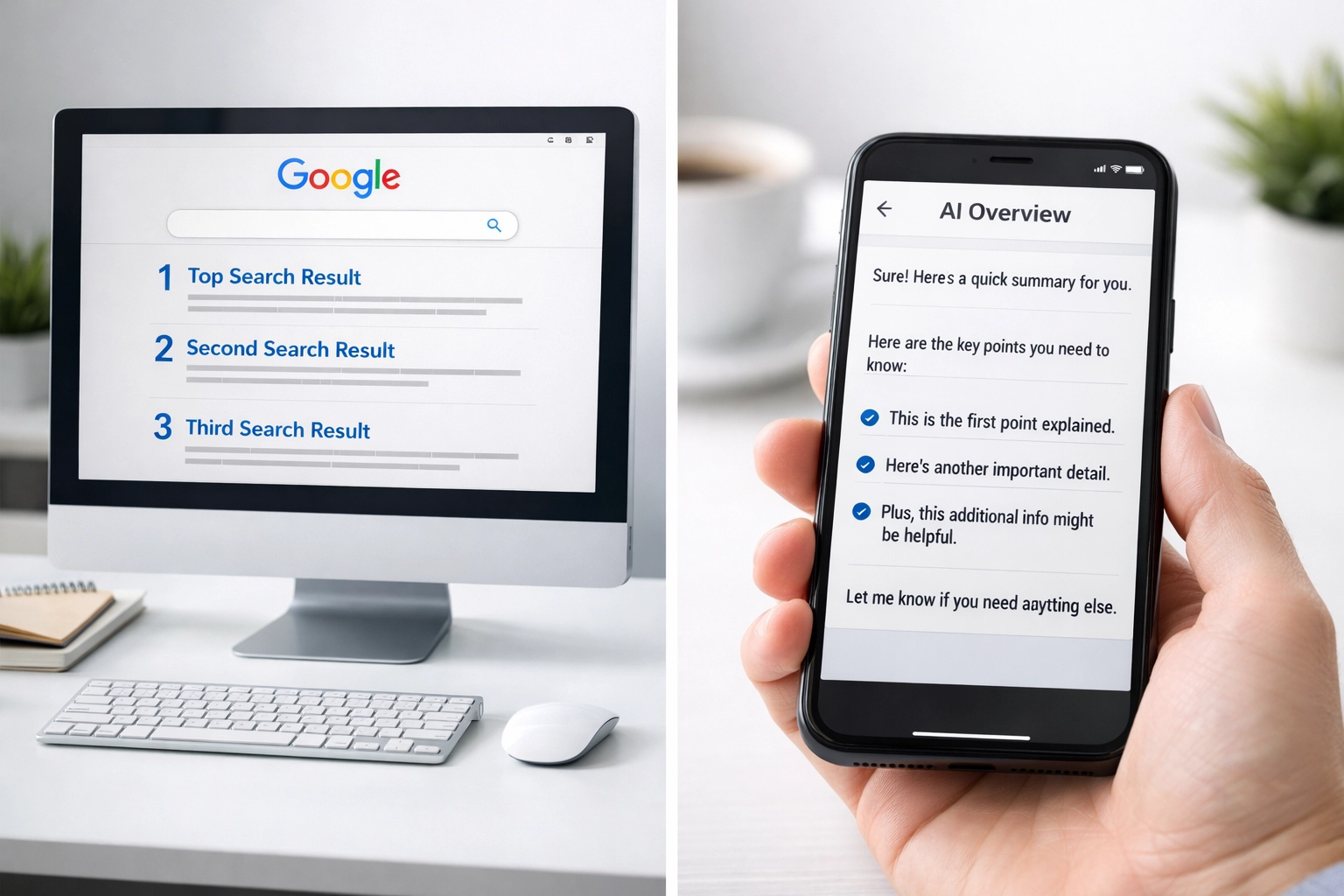
Here’s what makes this worse: AI-generated answers are unpredictable. Studies show that asking the same question multiple times to ChatGPT or Google’s AI Overview produces different brand recommendations in different orders each session. Your site might appear once, then disappear the next time someone asks the same question.
That variability makes traditional traffic analysis completely useless for measuring AI visibility.
Why Ecommerce Sites Are Structurally Invisible to AI
Most product pages are built to convert humans, not to be parsed by language models. That’s the core problem.
On top of that, even when you think you’re “visible,” AI often cites sources that aren’t even winning traditional SEO. Onely’s SGE research found 43% of sources cited were not ranking in the top 10 organic results for the same query. That’s structural invisibility in numbers.
Source: Onely — https://www.onely.com/blog/ (SGE study / analysis)
Here’s what I see constantly when I audit Shopify and Magento stores:
- Product descriptions written for emotional persuasion, not semantic clarity
- Schema markup that technically validates but doesn’t answer the questions AI systems are actually asking
- Navigation structures that make sense visually but create contextual confusion for crawlers
- Review widgets that JavaScript-render after page load (invisible to most AI scrapers)
- Faceted navigation creating hundreds of thin, duplicate-content URLs
AI systems need context-dense, entity-rich content that explicitly answers questions. Your “Free shipping on orders over $50!” banner isn’t helping.
Manual Method: Check Your Own AI Visibility in 15 Minutes
Forget rank trackers. Here’s how I audit AI visibility for clients: and you can do this right now:
Step 1: Build Your Query List
Write down 5-10 questions your customers actually ask. Not SEO keywords: real questions:
- “What’s the best coffee grinder under $100?”
- “Do ceramic cookware sets scratch easily?”
- “Can you wash heated blankets in the washing machine?”
Step 2: Ask Multiple AI Systems
Go to:
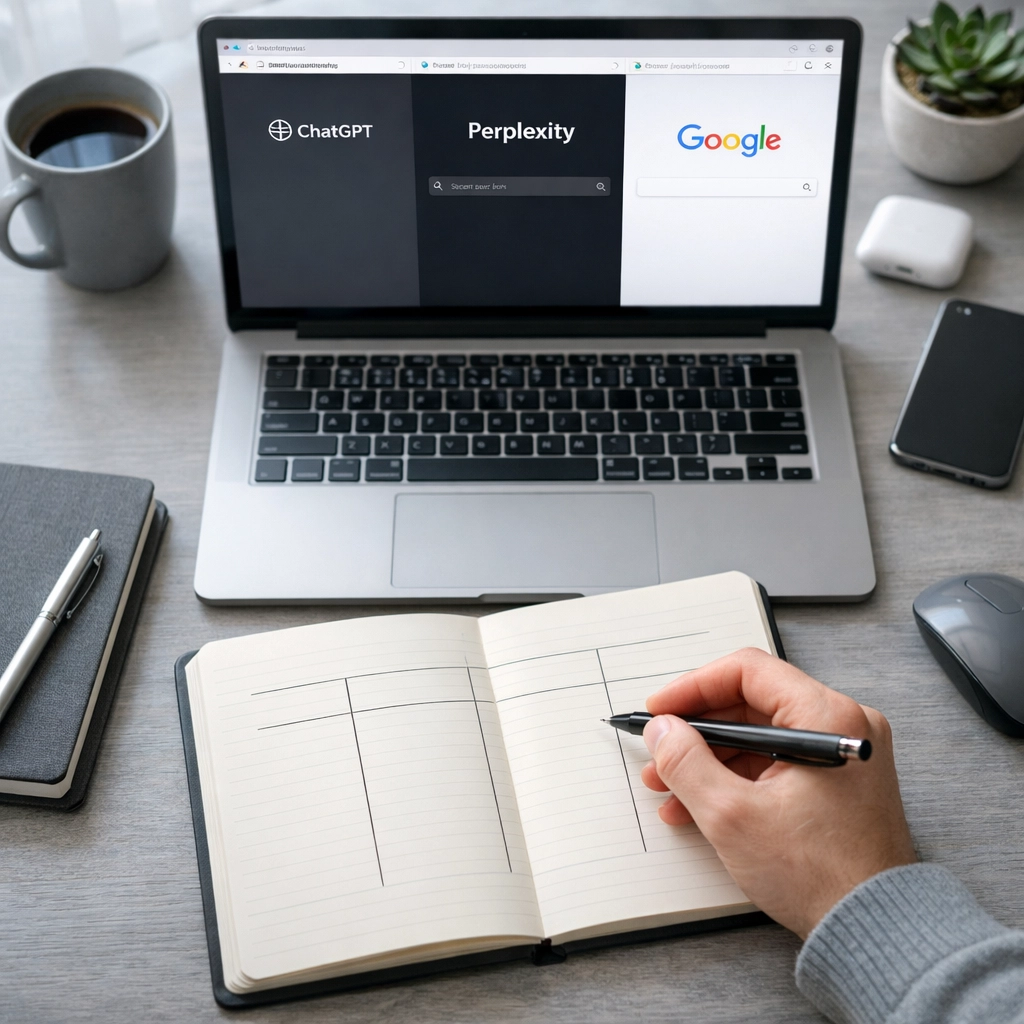
- Google (look for the AI Overview box at the top)
- ChatGPT (GPT-4 or the search-enabled version)
- Perplexity AI
- Claude (with web search enabled)
Ask the same questions. See who gets cited.
Step 3: Track the Pattern
Create a simple spreadsheet. For each question, note:
- Does your site appear at all?
- Which competitors get cited?
- What type of content gets cited (blog post, product page, comparison chart)?
- Does the AI link to your site, or just mention your product name?
Golden Fact: Google’s AI Overviews often mention product names but link to organic listings instead of the brand’s website: meaning you get brand visibility but zero traffic.
This is the cruel joke of AI visibility. You’re doing the marketing work; Google’s keeping the clicks.
Tool-Based Method: What Google Actually Sees
Here’s where it gets forensic. You need to understand what Google’s AI systems are interpreting from your pages.
Google Search Console: Your First Diagnostic
Log into Search Console and navigate to Settings > Preview Controls. This shows you how Google is interpreting your content for AI-generated answers.
Look for:
- Which pages Google considers “eligible” for AI Overview features
- Whether your structured data is being used (or ignored)
- How your meta descriptions are being rewritten by Google’s AI
Most ecommerce sites are shocked to discover Google is completely rewriting their product descriptions for AI Overviews: often badly.
Schema Markup Validator: The Brutal Truth
Run your top 10 product pages through Google’s Rich Results Test. Don’t just check if it validates: check what it’s validating.
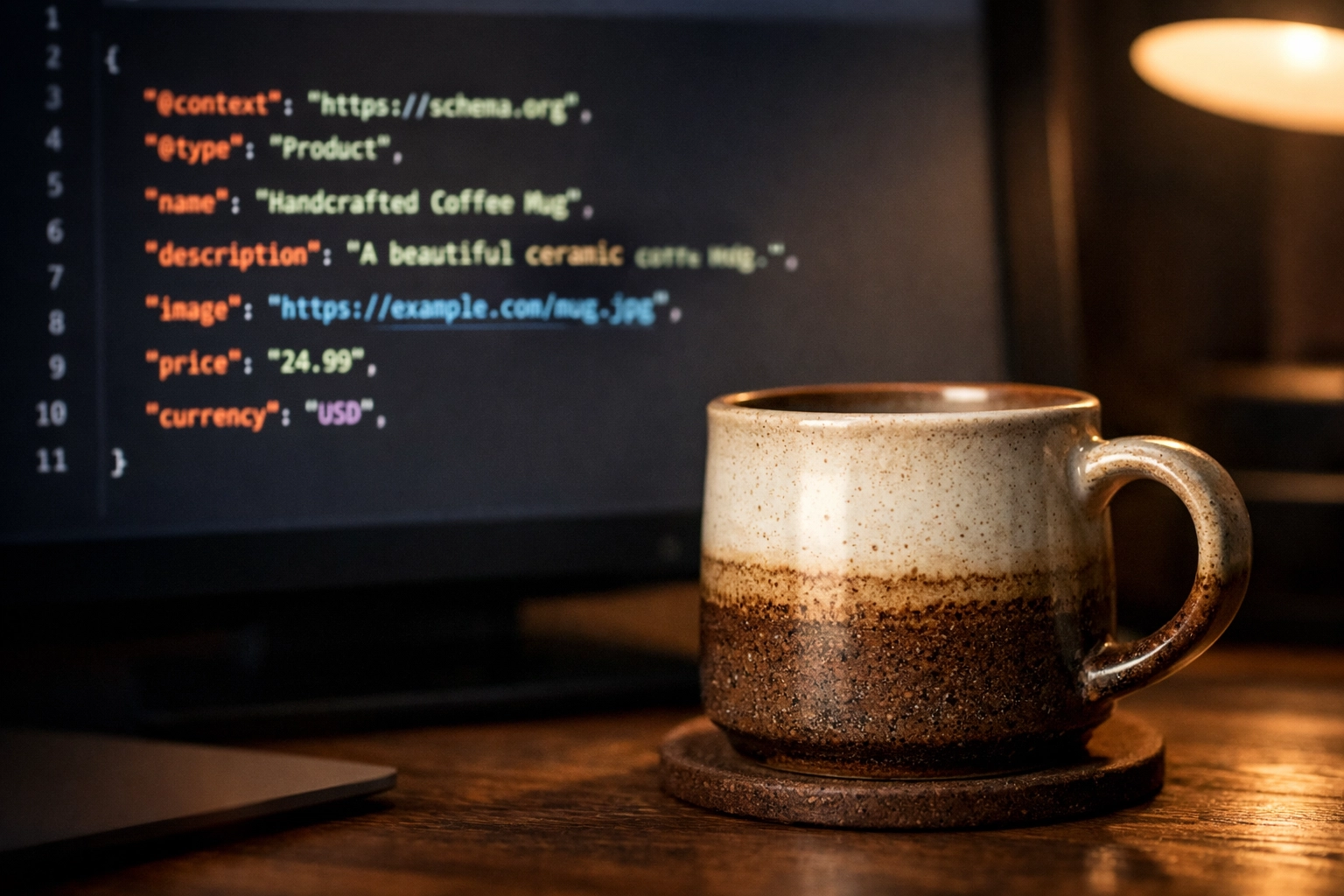
I see this constantly: Shopify stores with perfectly valid Product schema that’s missing:
aggregateRating(because reviews are JavaScript-rendered)brand(because it’s buried in a navigation menu)offers.availability(because inventory sync is broken)
AI systems can’t infer what’s missing. If the schema doesn’t explicitly state it, it doesn’t exist to the AI.
View Your Page as JSON-LD
This is my favorite diagnostic trick. Install a browser extension that extracts JSON-LD structured data, then view your product pages through it.
You’re not looking at a beautiful product page anymore. You’re looking at what the AI sees: a sparse, context-free list of properties.
Does it make sense? Does it answer questions? Or is it just technically compliant garbage?
Most ecommerce platforms ship with schema templates that satisfy validators but provide zero semantic value.
What the AI Actually Needs to See
Here’s what I prioritize when I’m auditing ecommerce sites for AI visibility: and it’s not what most technical SEO checklists recommend.
Research on AI-generated summaries suggests Google tends to favor self-contained answers and tight, quotable passages—often in the neighborhood of ~134–167 words—because they’re easy to lift into a synthesized response without needing extra context. If your “answer” is smeared across tabs, accordions, and template fluff, you’re basically asking the model to do reconstruction work. It won’t.
Source: (research summarized across SEO/AI overview analyses; align your content blocks to the 134–167 word “extractable passage” pattern)
Entity Density in Product Descriptions
Your product descriptions need to be entity-rich without sounding like keyword-stuffed spam. That means:
- Explicitly naming materials, dimensions, compatibility
- Answering common questions within the description itself
- Including comparison context (“lighter than aluminum, more durable than plastic”)
Golden Fact: AI systems prefer descriptions that contain 15-25 named entities (brands, materials, dimensions, use cases) in the first 200 words.
Natural Language FAQ Sections
Don’t bury your FAQ in an accordion widget that loads via JavaScript. Put it in the HTML. Make it crawlable.
Better yet: Structure each Q&A pair with FAQPage schema so AI systems know exactly what question you’re answering.
Review Content Accessibility
If your reviews are loaded via a third-party widget (Yotpo, Bazaarvoice, Trustpilot), there’s a good chance AI systems can’t read them.
Test this: View your product page with JavaScript disabled. Do the reviews appear? If not, neither can most AI scrapers.
The Magento/Shopify Specific Problems
Platform-specific issues I see constantly:
Shopify:
- Default schema implementation is minimal and generic
- Product variants create confusion (AI systems don’t know if “Blue Medium” is a different product)
- App-injected content (reviews, Q&A, recommendations) often isn’t crawlable
Magento 2:
- Configurable products create duplicate schema across child products
- Layered navigation generates thin parameter-based URLs that dilute authority
- Extension conflicts break schema output without throwing visible errors
Both platforms require custom schema work to be AI-legible. Out-of-the-box implementations won’t cut it.

The Uncomfortable Reality About AI Traffic
Even if you fix everything: even if you start showing up in AI Overviews consistently: here’s what you need to understand:
Mike Khorev has documented cases where traditional organic click-through rates drop by as much as 61% when an AI Overview is present. So yeah, you might “win” the mention and still lose the visit.
Source: Mike Khorev — https://mikekhorev.com/ (AI Overviews / CTR impact analysis)
AI-cited traffic doesn’t behave like organic traffic.
Users who get their answer from an AI Overview are less likely to click through. When they do click, they’re further along in the buying journey: but there are fewer of them.
I’ve tracked this across multiple clients: AI visibility increases brand mentions but decreases top-of-funnel traffic. It’s a trade-off, not a silver bullet.
The question isn’t whether to optimize for AI. You don’t have a choice: this is the future of search. The question is whether you’re going to do it strategically or just hope your existing SEO work carries over.
It won’t.
Your Next Step: The 48-Hour Audit
Here’s what I’d do if this were my store:
- Spend 2 hours manually checking AI visibility across the methods I outlined above
- Screenshot everything: you need baseline data
- Audit your top 20 product pages for entity density and schema completeness
- Fix the obvious gaps (missing schema properties, JavaScript-hidden content)
- Re-check in 30 days to see if AI citation patterns change
This isn’t a one-time fix. AI systems are constantly retraining, and their citation preferences shift. You need ongoing monitoring.
If you’re running a seven-figure ecommerce operation and this all sounds like forensic detective work you don’t have time for: it is. That’s why I do technical SEO audits specifically for Shopify and Magento stores.
But whether you hire someone or do it yourself, you need to know where you stand. Ignorance isn’t bliss here. It’s leaving money on the table.