

Your products might be invisible.
Not to Google. Not to your customers. To something far more dangerous: AI shopping agents.
When a shopper asks ChatGPT, Perplexity, or Google’s AI Overviews to “find waterproof hiking boots under $200 that ship by Friday,” these agents don’t browse your website. They don’t read your clever product descriptions. They query structured data feeds and parse machine-readable attributes. If your ecommerce infrastructure can’t speak that language, your products simply don’t exist.
TL;DR: AI shopping agents are rewriting discovery, and most Shopify stores are invisible to them. We’re breaking down the 10 technical fixes that make your products “agent-ready”, from Schema.org implementation to Merchant Center feed hygiene. This isn’t optional anymore.
Why This Matters Right Now
We recently wrote about Shopify rewiring discovery with agentic commerce. That was the strategic view. This is the tactical execution.
Here’s the problem: Your ecommerce store was built to persuade humans, not inform algorithms.
AI agents don’t care about your hero images, your brand story, or your aspirational lifestyle photography. They care about GTINs, real-time inventory sync, and whether your Schema.org markup is complete. When a shopping agent evaluates “waterproof hiking boots,” it’s looking for structured attributes it can programmatically assess, waterproof rating, price, shipping speed, availability.
If those data points don’t exist in machine-readable format, the agent moves on to your competitor.
The merchants with 95%+ data fill rates on mandatory fields see significantly better agent discovery. Below 80%? Your products are routinely skipped.
That’s not theory. That’s the new reality of ecommerce SEO.

The Foundation: You Can’t Build on Broken Infrastructure
Before we get into the 10 fixes, let’s acknowledge the elephant in the room.
If your site is slow, bloated with unused app code, or has a chaotic URL structure, none of this matters. You need the foundational layer of SEO, what we’ve called Maslow’s hierarchy of needs for technical SEO, before you can optimize for AI agents.
Speed. Clean code. Proper canonicalization. Structured site architecture.
That’s table stakes. Now let’s talk about the 10 technical fixes that make your products discoverable to the machines that are increasingly controlling the buy button.
The 10 Technical Fixes: Making Your Store Agent-Ready
1. Schema.org Product Markup (The Non-Negotiable)
If you’re not using Schema.org Product markup on every product page, you’re invisible. If you want a straight implementation walkthrough (not AI fluff), Hashmeta’s guide is a solid reference: Hashmeta: Product Schema Markup implementation guide.
AI agents rely on structured data to understand what you’re selling. The Product schema type tells agents your product name, brand, image, price, availability, and SKU. Pair it with Offer schema to communicate pricing, currency, and condition. Add AggregateRating schema for review data.
Golden Fact: LLMs parse Schema.org markup as a “source of truth” when traditional product feeds are incomplete or conflicting.
Most Shopify themes include basic product schema by default, but it’s often incomplete. Audit yours using Google’s Rich Results Test. Make sure every product page includes:
Producttypename,image,descriptionsku,gtin(more on this in a second)brandofferswithprice,priceCurrency,availability,url
If you’re pressure-testing what “complete” looks like in the wild (including common mistakes like mismatched availability/price), Hashmeta covers the required properties and the usual failure modes well: Hashmeta: Product Schema Markup implementation guide.
This is how agents understand what you sell at scale.
2. GTIN Assignment (The Universal Product ID)
Every standard retail product needs a GTIN: Global Trade Item Number. This is the barcode number (UPC, EAN, ISBN) that identifies your product across every database and marketplace.
GTINs help AI agents match your products against their internal knowledge graphs. Without them, agents can’t confirm that your “Nike Air Zoom Pegasus” is the same product Amazon is selling for $130.
If you manufacture your own products or sell custom goods, use MPN (Manufacturer Part Number) instead. Just don’t leave it blank.
3. Merchant Center Feed Hygiene (The Second Source of Truth)
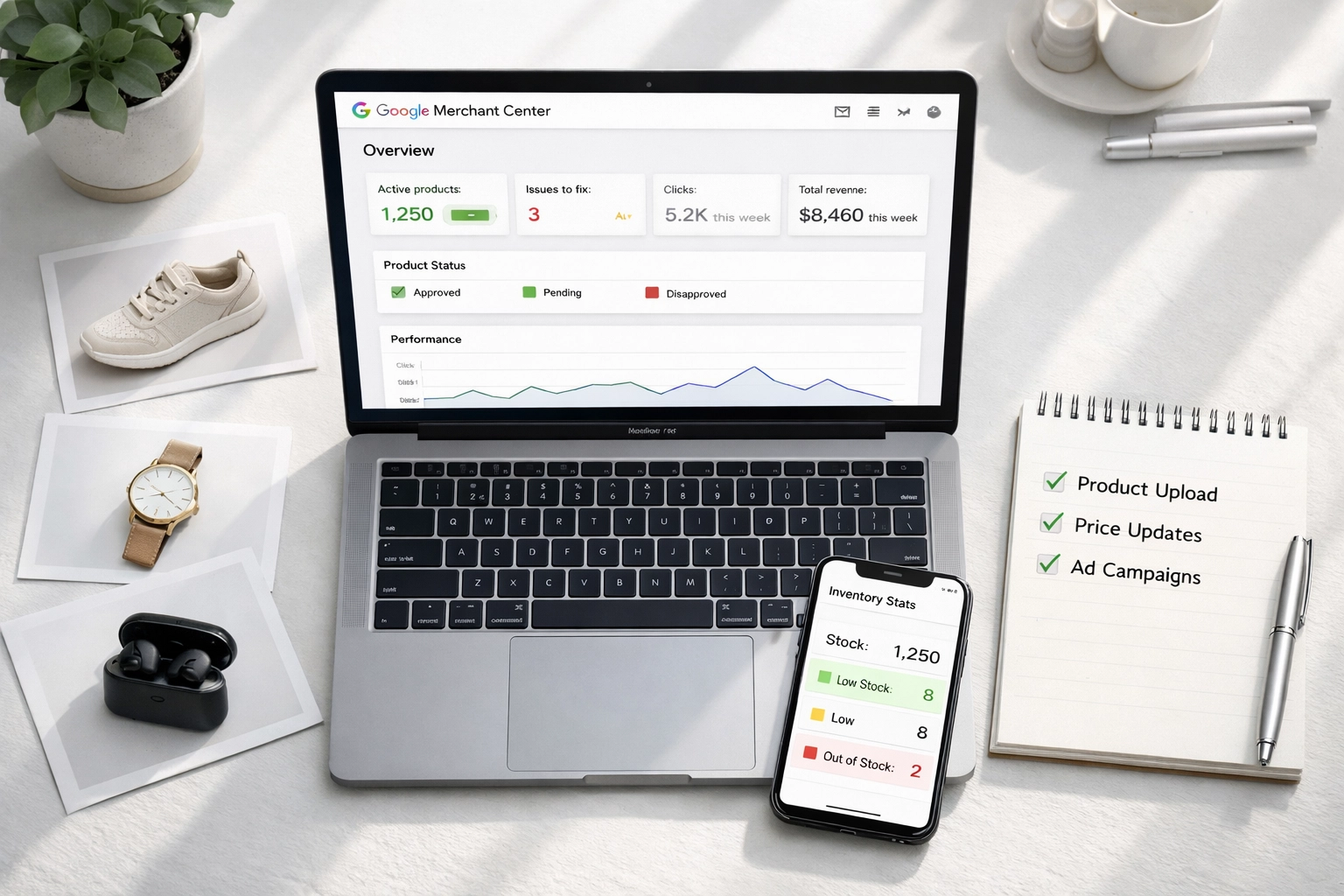
Your Google Merchant Center feed isn’t just for Shopping ads anymore. It’s increasingly used by AI agents as a structured data source. If you want a practical “are we actually ready?” punchlist, SKU Analyzer has a no-BS checklist worth skimming: SKU Analyzer: Merchant Center UCP readiness checklist.
We’ve seen LLMs cross-reference Merchant Center feeds when evaluating product availability, pricing, and shipping. That means your feed needs to be pristine:
- Zero disapproved products
- Real-time inventory sync
- Accurate pricing (no mismatches between feed and site)
- Complete attribute coverage (brand, GTIN, condition, shipping)
Marcel Digital has a good breakdown of why feed hygiene is now directly tied to AI Overviews visibility (not just Shopping ads): Marcel Digital: Optimizing product feeds for AI Overviews, LLMs, and Merchant Center.
Merchants with 95%+ data fill rates get prioritized. Below 80%, you’re penalized algorithmically. The “Golden Record” framing shows up a lot in ops/fulfillment circles too, because missing attributes don’t just hurt discovery—they kill downstream execution. eFulfillment Service has a helpful explainer on why attribute completion directly impacts visibility and outcomes: eFulfillment Service: Golden Record + attribute completion visibility.
4. Semantic Clarity in Product Descriptions (Stop Writing for Humans Only)
Your product descriptions need to be descriptive, not just creative.
AI agents don’t understand clever brand copy. They’re looking for material composition, dimensions, compatibility, technical specifications, and use cases. When you write “Experience the revolution in comfort,” an agent learns nothing. When you write “Memory foam insole, 12mm cushioning, waterproof Gore-Tex upper, fits true to size,” the agent can evaluate fit.
This doesn’t mean your descriptions need to be boring. It means they need to be informationally dense.
Include:
- Material composition
- Dimensions and weight
- Compatibility (devices, sizes, models)
- Care instructions
- Use cases and applications
Golden Fact: Product descriptions optimized for semantic clarity improve both AI agent discovery and traditional SEO rankings: you’re not choosing between the two.
5. Attribute-Rich Product Titles
“Running Shoe” tells an AI agent almost nothing.
“Nike Air Zoom Pegasus 40 Men’s Running Shoe – Black/White, Sizes 7-13, Breathable Mesh” tells it everything.
Your product titles need to include the attributes that agents use to filter and evaluate. Brand, product line, key features, color, size range. Don’t stuff keywords: just include the information a shopper would use to decide if this is the right product.
Most Shopify stores under-optimize titles because they were thinking about how they look in a grid layout, not how they parse to an algorithm.
6. Real-Time Inventory and Price Accuracy (Zero Tolerance for Drift)
AI agents have zero tolerance for showing items as “in stock” when they’re sold out. Zero tolerance for price mismatches between your feed and your live site.
Every time an agent recommends a product that’s unavailable or mispriced, it downgrades your store’s reliability score. Do it too many times, and you’re deprioritized permanently.
Your inventory and pricing sync needs to be real-time, not batched overnight. Most Shopify apps sync every 15-30 minutes. That’s not fast enough for high-velocity categories. Evaluate your app stack and make sure your feed is pulling live data.
7. Canonical Tags and URL Structure (Avoid Agent Confusion)
If you have the same product accessible via multiple URLs: filtered category pages, variant URLs, duplicate product pages: you’re confusing AI agents.
Canonical tags tell search engines (and increasingly, agents) which version of a URL is the “true” version. Make sure every product page has a self-referencing canonical tag and that variant URLs (color, size) canonicalize back to the parent product.
Agents don’t deduplicate the way Google does. They’ll treat each URL as a separate product, and your inventory data will look fragmented.
This is basic ecommerce SEO, but it matters even more in the agent era.
8. Standardized Brand and Variant Management
Use “Nike” everywhere. Not “NIKE,” not “nike,” not “Nike Inc.”
Variation in brand formatting confuses agent matching systems. They’re looking for exact string matches across feeds, schema, and product pages. Inconsistency makes your products harder to match against their internal knowledge graphs.
The same applies to variant management. If you sell “blue running shoes in sizes 7-13,” each size needs accurate inventory and proper parent-child relationships in your product feed. Agents need to know that the size 10 is in stock, but the size 12 is backordered.
9. Structured Shipping and Return Data
Agents evaluate shipping costs, delivery speeds, return windows, and geographic coverage programmatically. If that data isn’t machine-readable, your products get deprioritized.
Include in your Merchant Center feed:
- Shipping costs by region
- Estimated delivery times
- Return policy (days, conditions, fees)
- Geographic restrictions
Most Shopify stores leave this blank or use vague “calculated at checkout” language. That’s a death sentence for agent discovery.
10. Linked Data and the Universal Commerce Protocol
This one’s forward-looking, but worth watching. Dan Taylor over at SALT.agency has been one of the clearest voices on what this becomes in practice—especially with ACP (Agentic Commerce Protocol): SALT.agency (Dan Taylor): Optimising for the Agentic Commerce Protocol (ACP).
Shopify is experimenting with linked data standards: machine-readable product information that lives across multiple platforms. Think of it as Schema.org on steroids. The idea is that your product data becomes portable, accessible to any AI agent without requiring a proprietary feed integration.
We’re not at universal adoption yet, but stores that adopt linked data standards early will have a discovery advantage as agent commerce scales. If you want a quick reality check on what “agent-ready listings” look like from a multichannel feed perspective, ChannelEngine published a solid checklist-style guide: ChannelEngine: prepare product content for AI-shopping agents.
For now, that means keeping your Schema.org implementation clean, your GTINs accurate, and your feeds comprehensive. The infrastructure is converging.
How to Measure Your Agent Readiness
Want to know if your products are visible to AI agents? Also: stop treating “AI search optimization” like it’s a vibe. Backlinko’s ecommerce AI search guide is one of the better summaries of what changes (and what doesn’t) when discovery shifts into LLM answers: Backlinko: Optimize your ecommerce store for AI search.
Ask ChatGPT or Perplexity to find products in your category with specific attributes. Do your products appear? Is the pricing accurate? Is the availability correct?
That’s your baseline test.
Then, audit your infrastructure:
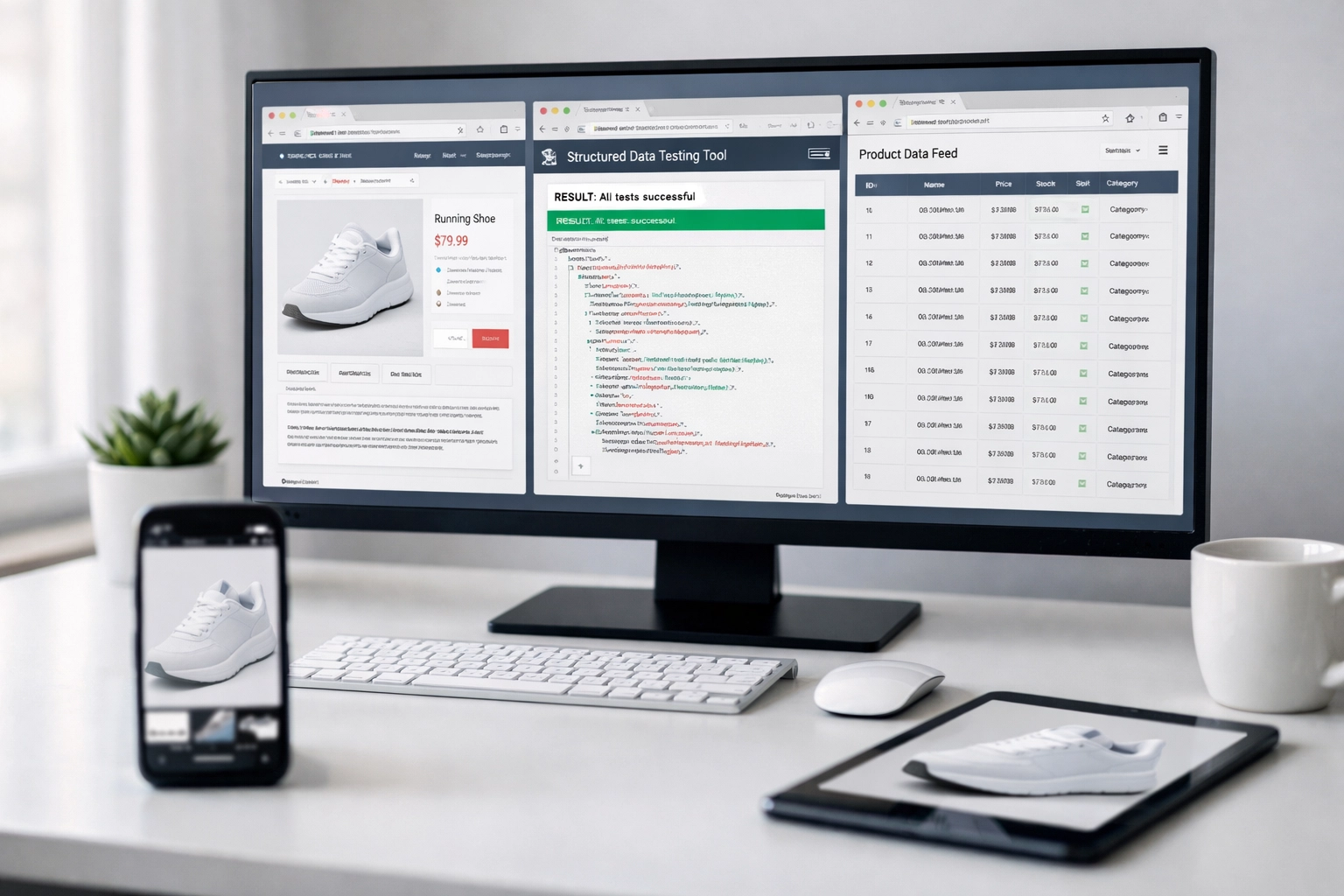
- Run Google’s Rich Results Test on 10 random product pages. Are they showing complete Product schema?
- Check your Merchant Center feed diagnostics. What’s your data quality score?
- Review your disapproved products. What’s causing rejections?
- Use Screaming Frog to audit canonicalization and URL structure.
Stores with 95%+ feed coverage and complete Schema.org markup are agent-ready. Below 80%, you’re leaving money on the table.
The Bigger Picture: One Infrastructure, Multiple Discovery Channels
Here’s the beautiful part: The same structured data that makes your products visible to AI agents also improves performance across Google Shopping, Amazon, social commerce, and on-site search.
This isn’t a separate workstream. It’s the foundation of modern ecommerce SEO.
When you optimize for machine readability, you’re future-proofing against the next five years of discovery evolution. Whether that’s ChatGPT Shopping, Google’s AI Overviews, or whatever Meta and TikTok build next: your products will be ready.
The brands that ignore this are building for a world that no longer exists.
Need a technical SEO audit to see where your store stands? We run diagnostic audits specifically for Shopify stores preparing for agent commerce. Let’s look under the hood and figure out where you’re losing visibility.